Thomas Howard, Earl of Surrey
The Constant PrincessThomas Howard, Earl of Surrey, is a veteran soldier, royal adviser, and commander in the campaign against Scotland. His role joins frank counsel to delegated command: he warns Katherine of Aragon about the dangers of war, recognizes the strategy behind her preparations, and leads the first English engagement while she keeps a reserve force to guard the southern approaches. The Scots’ defeat is ultimately reported to Katherine as a victory made possible by the army she built.
Identity and Counsel
Thomas Howard appears as an experienced soldier whose authority rests on practical knowledge of military risk. When Katherine discusses sending Henry VIII to campaign in France while preparing to face the Scots, Howard cautions her against treating kingship as protection from danger. He observes that few kings die in battle and that ransom is more common, but contrasts that risk with the greater peril of sending an English army across the narrow seas to France and then fighting Scotland with whatever forces remain. His point is not that war is safe, but that Katherine’s proposed division of military strength could leave her with the more dangerous problem.
In the same exchange, Howard makes clear that he understands the plan Katherine has not openly explained. When she asks who has guessed what she is doing, he answers, “Only me.” The answer marks him as more than a source of general caution: he has read her preparations and recognizes the strategic logic beneath them. His discretion also gives Katherine a military confidant at a moment when her plan depends on coordinating an overseas campaign with the defense of the kingdom at home.
His counsel can be blunt. Speaking of Henry’s need to learn battlefield leadership, Howard contrasts leading men into battle with leading boys into a bawdy house, then immediately apologizes for his language. The brief exchange combines familiarity with courtly restraint: he speaks plainly to Katherine, but remains conscious that she is queen. His concern is that Henry acquire the experience expected of a king, even as Katherine recognizes the danger involved.
Command and the Defensive Plan
During the Scottish advance, Howard commands the force intended to meet the Scots, while Katherine directs a separate army and maintains it as a reserve. Messengers pass continually between the two forces. Their arrangement gives Howard responsibility for making the first attack when an opportunity arises, but it is part of a larger defense rather than a plan resting on one decisive encounter. If his force is defeated, Katherine’s army is to confront the Scots farther south; if that defense also fails, the commanders plan to regroup, summon London’s citizens, raise earthworks around the city, and, as a last resort, withdraw to the Tower until Henry can reinforce them from France.
Howard is anxious about being ordered to attack before Katherine joins him. He would prefer to wait for her force, which would unite their armies, but Katherine insists that he engage first. She explains the logic of keeping her troops in reserve: should the Scots win the first battle, an intact force must still stand between them and the south. Howard’s preference reflects the immediate appeal of greater strength at the point of contact; Katherine’s decision weighs that advantage against the consequences of losing the only reserve capable of protecting the road to London.
Katherine’s strategy is explicitly a campaign of defense and repeated fallback positions, not a wager on one battle. She plans for defeat as well as victory, identifying where the army can retreat and regroup if an engagement goes badly. Howard’s place within this plan is therefore both independent and bounded: he is the commander in the field, but his first attack is one stage in a defense designed to survive a reverse and keep the capital from being exposed.
Counsel at Flodden
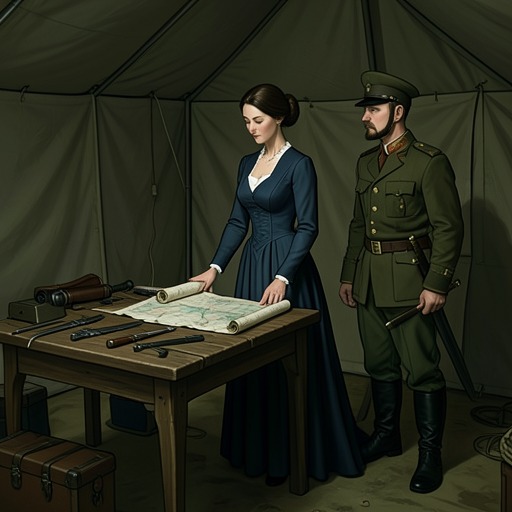
When Howard reports that the Scots are encamped on high ground at Flodden, Katherine studies his map and sees the danger of a direct assault. The Scots command the view to the south; an uphill attack would expose the English to archers above them and to a charge by the Highlanders. She sends Howard advice to seek a route around the Scottish position and approach from the north. Alternatively, he might feint, leave enough men to hold the Scots in place, and move the rest as if marching north, in the hope that they would pursue and leave the ridge for open ground.
The proposed northern approach has its own obstacle: a stream crosses the route, and the messenger confirms that the ground is boggy and may be impassable. Katherine nevertheless considers it the only possibility she can see. Crucially, she distinguishes advice from command. Howard, she tells the messenger, must judge the ground himself as the commander in the field; her firm instruction is that he must not attack uphill, but must either get the Scots off the ridge or surprise them from the rear. The episode presents their working relationship as an exchange between strategic oversight and battlefield judgment, not as a simple transfer of every decision to the queen.
Victory and Narrative Role
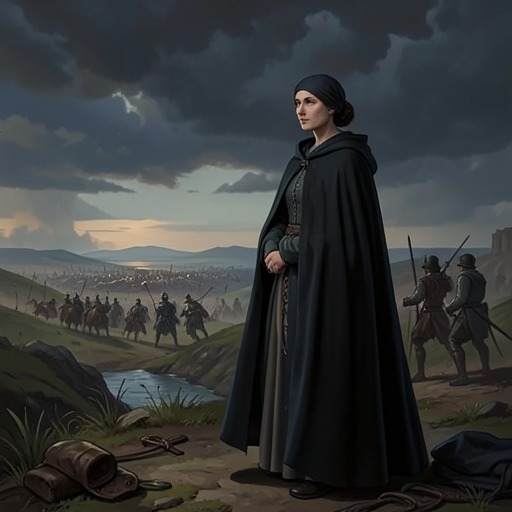
The news reaches Katherine through a messenger still marked by the battle’s dirt. He reports that the King of Scotland is dead, along with twenty Scottish lords, bishops, earls, and abbots, and describes the defeat as one from which Scotland will not readily recover. When Katherine asks whether they have won, the messenger confirms that they have. He says the earl wanted her to know that her men, raised, trained, and armed by her, had done what she ordered, and calls it her victory.
Howard’s characterization is consequently defined less by a personal account of combat than by his place in the campaign’s chain of judgment and responsibility. He warns Katherine about strategic exposure, understands the plan she is keeping close, commands the force assigned to attack, and receives tactical guidance that leaves room for his own decision in the field. The victory report then redirects attention from the commander to the queen who organized the army and designed the defense. Howard’s role helps make that success collective: he is the experienced soldier who acts within Katherine’s wider plan, while the reported outcome recognizes her preparation as the source of England’s safety.